The seven tells that give a render away
Most people spot a render in two seconds but cannot say why. Here are the seven specific tells, and what separates imagery that reads as photography.
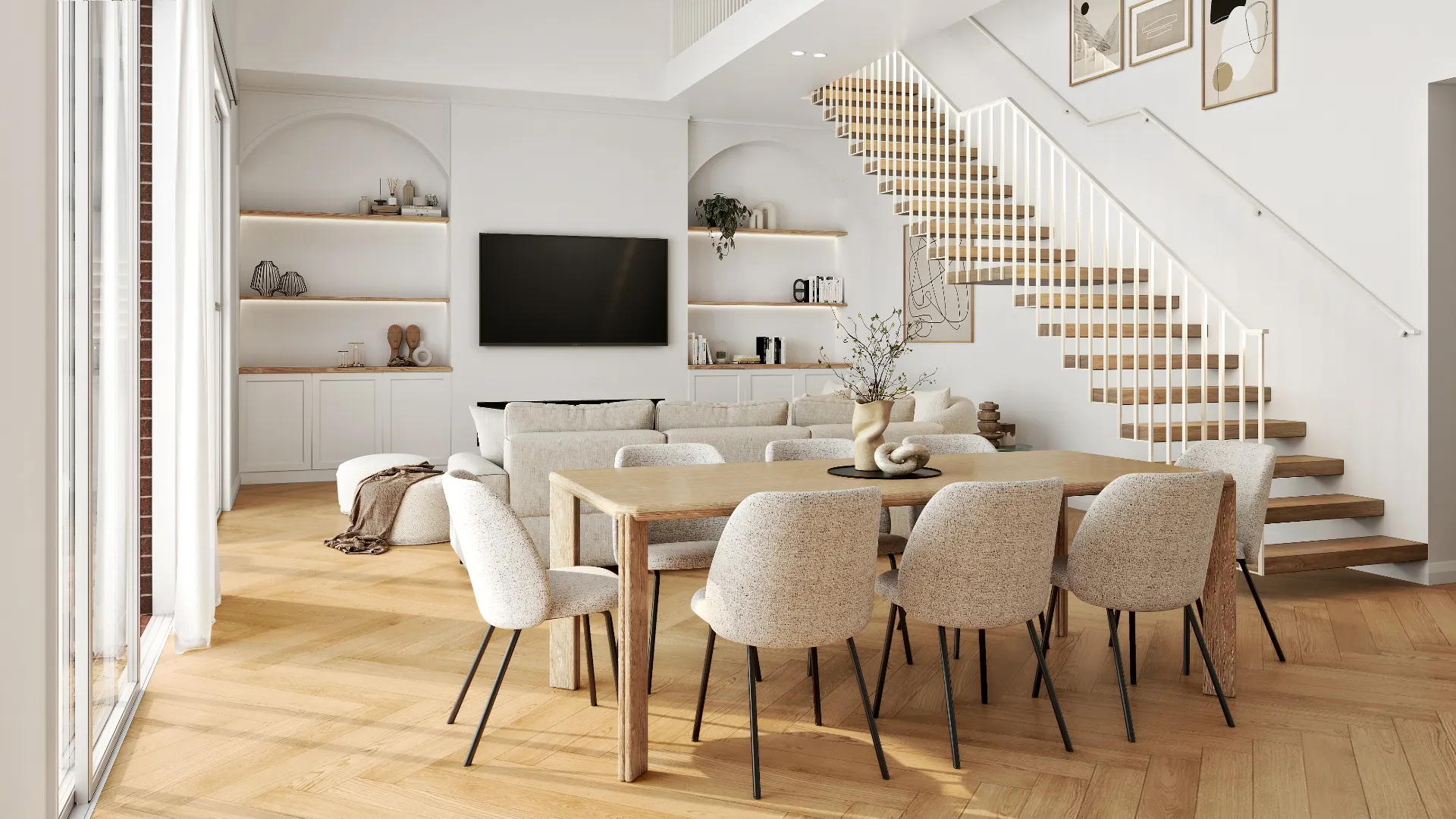
Show someone an architectural render and they will usually know it is a render before they could tell you why. That instant recognition is the whole problem, because the moment an image is identified as a render it stops being evidence and becomes an advertisement — and people discount advertisements.
Here is what is actually triggering it.
1. The light has no source
The commonest tell by a distance. In a real photograph you can trace every shadow back to something that made it. In a weak render the light is ambient and directionless — everything is evenly, plausibly lit and nothing casts a shadow that means anything.
Real light is directional and it is uneven. A room lit through one window is bright at the sill and gloomy in the far corner. Renders that try to keep everything legible end up keeping everything flat.
2. Everything is brand new
Real buildings have been rained on. Mortar has efflorescence, decking has silvered slightly, window reveals have collected dust in the corners. Render materials arrive factory-fresh and stay that way, and a facade where every surface is in mint condition reads as a product shot rather than a building.
The fix is not grime. It is variation — the same brick at five slightly different tones across a wall.
3. The glass is doing nothing
Glass in a real photograph is busy. It reflects the sky, the building opposite, the photographer. It has a slight green cast at the edges. In a weak render glass is either a flat blue panel or perfectly transparent with a bright grey interior behind it.
Look at any render you suspect. If the windows are not reflecting something specific and identifiable, that is a large part of why it is failing.
4. The people are wrong
Cut-out figures are the fastest way to destroy an otherwise good image. The usual failures: lighting that doesn’t match the scene, shadows that don’t land, scale that is subtly off, and — most tellingly — everyone walking and nobody standing still.
Fewer figures, better placed, beats a crowd every time. Often the right number is zero.
5. The landscape is a catalogue
Identical trees at identical heights, evenly spaced. Real planting is uneven — different ages, different species, some struggling, some overgrown. Turf in renders is a uniform green carpet; real turf has wear paths where people cut the corner.
6. The camera is not a camera
Real architectural photography is shot on a tilt-shift lens with verticals kept parallel, from roughly eye height, at a focal length around 24–35mm. Renders are frequently made from a floating viewpoint three metres up, at a wide angle no photographer would use, with converging verticals nobody would accept.
If the image is from a position a person could not physically stand in, the brain notices even when the viewer cannot articulate it.
7. There is no grade
The last one, and the one most often skipped when a price is cut. A raw render out of the engine is technically correct and emotionally dead — even exposure, neutral colour, no contrast curve. Every photograph you have ever admired was graded.
Grading is the difference between “accurate” and “attractive”, and it is usually the first thing to go when a studio is working to a budget.
What this means when you are buying
None of these are solved by better software — every studio is using much the same tools. They are solved by hours, and by having someone senior enough to notice the reveal is wrong.
When you compare quotes, the useful question is not which renderer they use. It is: who is lighting this, and how long do they get?
See how we handle it across our work, or read our pricing — published openly, because the tier you need depends entirely on what the image has to do.